Start with how your family actually travels
A family caravan can look perfect in a listing, then feel crowded before you have reached the first overnight stop. The best family caravan layouts Australia has to offer are not necessarily the ones with the most berths or the largest dinette. They are the layouts that let your family eat, sleep, get changed and pack up without everyone standing in the same narrow aisle.
That means looking beyond the polished photos. Think about wet towels after a beach stop, kids needing the toilet at night, somewhere to sit when it rains, and who has to climb over whom to make the morning cuppa. A well-chosen layout makes travel feel easier. A poor one can turn even a beautiful van into hard work.
For most families, the right choice comes down to three things: the children’s ages, how long you intend to travel, and whether you usually stay in caravan parks or head further off the bitumen. There is no single winner for every crew, but a few layout styles consistently make family touring more comfortable.
Rear bunks with a front queen bed
This is the classic family caravan layout for good reason. Parents have a fixed queen bed at the front, while the kids sleep in bunk beds at the rear. The kitchen and lounge usually sit through the middle, with the bathroom often positioned beside or ahead of the bunks.
Its biggest advantage is separation. Children can settle into bed while the adults still have access to the lounge, kitchen and front bedroom. The front queen bed also means no daily bed conversion, which matters when you are travelling for weeks rather than taking one quick weekend away.
Rear bunks suit young children particularly well. They create a clear bedtime zone and give each child a space for a book, torch and a few treasured travel toys. Four-bunk versions can work brilliantly for larger families, although the extra beds can reduce wardrobe space and add length and weight to the caravan.
The trade-off is that some rear-bunk vans have a tighter bathroom or a narrower central living area. Check whether the bottom bunk is easy to access, whether the top bunk has a proper safety rail, and whether an adult can comfortably make the beds. If your children are tall teenagers, measure bunk length carefully. A layout that works at age six may not work at age 14.
Triple bunk layouts for growing families
Families with three children often gravitate to triple bunks, usually arranged across the rear wall or along one side of the van. This avoids turning the lounge into a bed each night and gives everyone a fixed place to sleep.
A triple-bunk caravan is practical, but it asks more of the rest of the floorplan. Storage is the main consideration. Three children create an impressive amount of clothing, shoes, games, food and wet-weather gear. Look for deep drawers, overhead cupboards that are genuinely usable, external lockers and room for a portable washing setup if you are away for extended periods.
It is also worth considering the family dynamic. Younger siblings may love being grouped together, while older kids may prefer the privacy of a separate rear club lounge or an independent bed arrangement. A caravan is compact by nature, so layout decisions affect everyone every day.
Family layouts with a rear club lounge
A rear club lounge is a strong option for families with older children, or for buyers who want the van to remain useful once the kids stop travelling with them. During the day, the rear area is a generous place to eat, play cards, do schoolwork or stretch out on a rainy afternoon. At night, it converts into one or more beds.
This flexibility is the appeal. Unlike a dedicated bunk room, the space can adapt as your family changes. It can also be ideal for a couple who occasionally brings grandchildren away, rather than needing permanent bunks every trip.
The compromise is the nightly setup. Converting cushions into beds is simple enough for a short break, but it can become tiresome on a long lap of Australia, especially when children want to go to sleep before adults are finished using the lounge. Check how quickly the conversion works and whether the made-up bed is long and supportive enough for the people who will use it.
Ensuite placement makes a bigger difference than expected
An ensuite is not essential for every family, particularly if most nights are spent in well-equipped holiday parks. But it can be a game changer when travelling with small children, stopping at free camps, or moving through regional areas outside peak season.
In many family vans, the ensuite sits at the rear beside the bunks. This can be handy because children have a short path to the toilet at night. In others, a central bathroom divides the parents’ bedroom from the children’s sleeping area, adding a little privacy and helping contain early-morning noise.
Pay attention to the bathroom door swing and the route to the toilet. Can a child reach it without walking through the parents’ bedroom? Can someone shower while another person uses the kitchen? Is there enough bench space for toiletries? These details may seem small at an inspection, yet they shape how the van works when all berths are occupied.
A full ensuite adds convenience, but it also takes up floor space and contributes to weight. If you favour remote travel, consider your water capacity, payload and towing limits alongside the floorplan. A feature-packed van is only a good family van if it can be safely and legally loaded for your trip.
Consider the kitchen and dining zone in bad weather
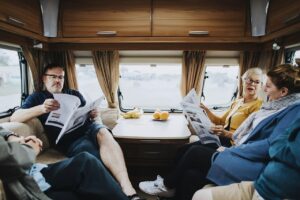
Most holiday photos are taken outside under an awning. The true test of a family layout is a wet afternoon when everyone is indoors. A workable dinette needs enough room for meals, colouring-in, laptops and a board game without blocking the main walkway.
An L-shaped lounge can feel more relaxed than a standard café dinette and may seat more people, but it can reduce open floor space. A café dinette is often easier for getting in and out, and some versions convert into an extra child’s bed. If you regularly travel with four or more people, sit everyone down during an inspection rather than assuming the seating will be adequate.
The kitchen should allow one person to prepare meals while others move through the van. Look for usable bench space, a pantry that opens fully, a fridge sized for your normal travel style and sensible access to the bins. Outdoor kitchens are popular, but they should complement the internal kitchen, not replace it. Wind, rain and chilly evenings are part of caravan life too.
Don’t let the floorplan hide a weight problem
When comparing the best family caravan layouts in Australia, it is easy to focus entirely on beds and bathrooms. Yet family touring places serious demands on payload. Food, clothes, bikes, camp chairs, recovery gear, water, toys and bedding add up quickly.
Before committing to a van, confirm its tare mass, aggregate trailer mass, payload and tow-ball weight. Then consider where your belongings will sit. Heavy items stored at the front, in a tunnel boot or on a rear bar can affect balance and ball weight. Your tow vehicle must also remain within its towing, gross combination and axle limits once the caravan and passengers are loaded.
A professional pre-purchase inspection and clear advice from an experienced caravan specialist can save costly surprises. The right layout is not just comfortable – it must be practical to pack and safe to tow.
Match the layout to the trips you will really take
A compact 17- or 18-foot bunk van may be easier to manoeuvre, lighter to tow and well suited to weekend escapes. For long-term touring with school-aged children, a 20- to 22-foot van with permanent beds, more storage and a comfortable indoor lounge may make the extra length worthwhile.
Off-road and semi off-road family caravans bring another set of decisions. Higher ground clearance, stronger suspension and increased water capacity can support more adventurous travel, but they may add weight and cost. If most of your family holidays are on sealed roads and in caravan parks, a well-built touring van may give you better value and a more generous interior.
When inspecting a van, bring the whole family if possible. Let the kids climb into the bunks, sit at the dinette and test the bathroom route. Open every cupboard, check the pantry, picture the laundry pile, and ask where the bikes and bulky gear will go. A layout should suit real routines, not just a brochure.
The best choice is the caravan that gives your family enough personal space to enjoy being together. Take your time, ask direct questions, and choose a layout that will still feel right after the novelty of the first trip has worn off.